
Mower Release Dates by Custody
A release date can mean a planned date, a completed physical release, the start of supervised release, the expiration of a sentence, or final discharge. Those are distinct milestones. The Mower County Jail record supplies the actual local release time when a booking ends. A Minnesota DOC record may instead show a date tied to the prison sentence or supervision. A court order can authorize release but does not prove when jail processing finished.
Pretrial custody is the clearest reason no fixed Mower County inmate release date may exist. Bond can be posted, a recognizance order can issue, a hold can appear, or the case can change. A sentenced county inmate has more definite terms, yet jail credit, local administration, court orders, and outside holds still matter. A state prisoner has a statutory sentence structure, although calculations and status can change.
- Projected date
- A planning date calculated from current sentence information.
- Supervised release
- The community portion of a Minnesota prison sentence.
- Expiration
- The end date attached to the sentence calculation.
- Final discharge
- The formal end of correctional authority shown in the discharge record.
- Detainer
- A request or hold from another authority that may prevent community release.
Find a Mower Inmate Release Date
Use the system that has the person now. The official Mower County roster covers the county jail. The MN DOC Public Viewer covers people connected to state correctional custody, not every county booking. Court records explain orders and sentences. They should be paired with the custodian's record when the question is the actual date and time of release.
- Identify the last known custodian. Distinguish Mower County Jail from a Minnesota DOC institution, federal custody, or another county.
- For a current county booking, open the official jail roster. A blank release field and `IN CUSTODY` mean there is no recorded release at the PDF's generation time.
- Open the Mower County criminal case in MCRO Case Search. Read bail, sentencing, jail-credit, commitment, warrant, and later order entries.
- For a state commitment, search the MN DOC Public Viewer by MNDOC number when possible, then open the individual result.
- Copy the exact date name and current status. Do not turn an expiration date or supervised-release date into a generic promise.
- If the public display is not enough, request the existing release calculation or public offender record from the jail or DOC.
The Mower County released-inmate workflow also explains how to match the short-lived jail entry with court and transfer records. It is available through the Mower County release search. A missing name from a current roster is not proof that the person returned to the community.
Mower DOC Release-Date Search
The Minnesota DOC “Search Individuals and Fugitives” page leads to the Public Viewer. Use an MNDOC number for the most precise match. A name result should be checked against the displayed birth date or other public identifier. Open the full record rather than relying on the search list. A Mower County Jail detainee belongs in this system only after a state commitment or transfer into DOC custody.
The captured Minnesota DOC Public Viewer shows the official search route used for state sentence records.
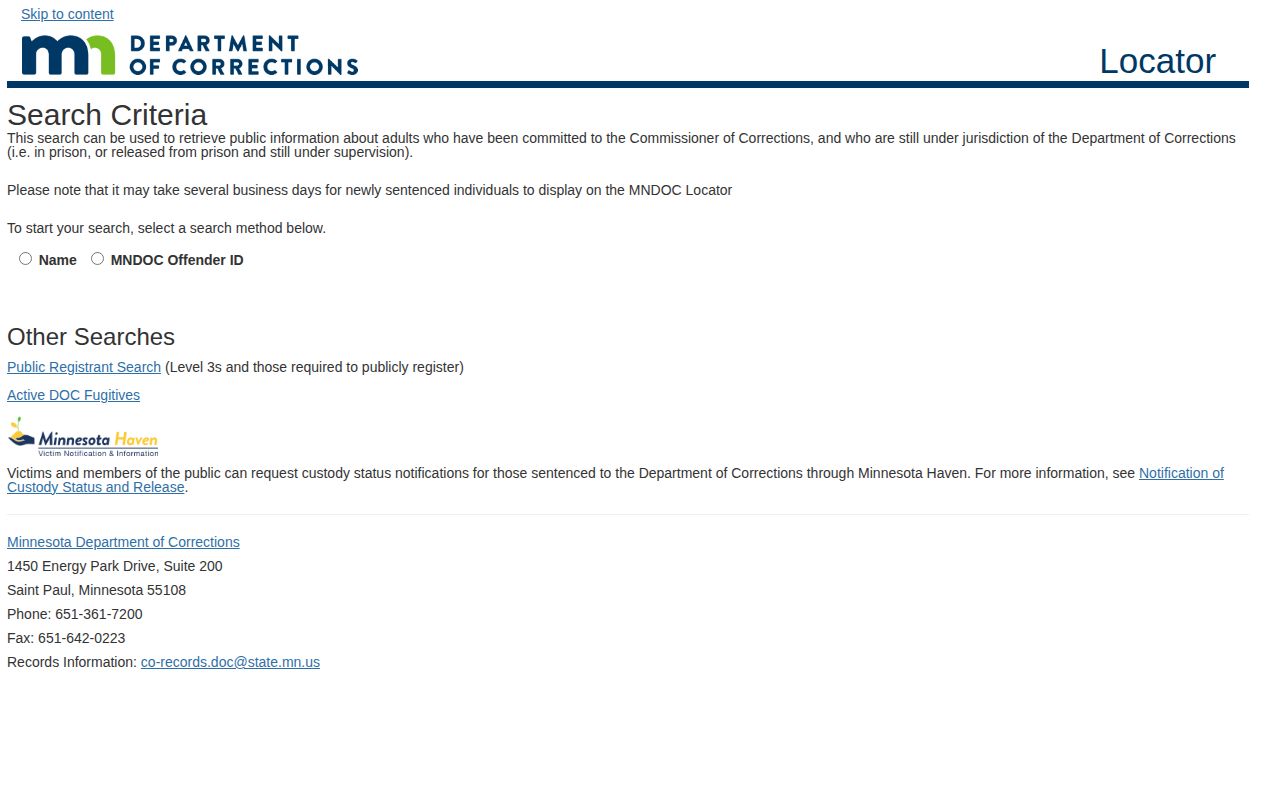
The image confirms the portal, not a universal field promise. Different record types may label dates differently. Report the live wording for the correct person and keep a planned prison-to-supervision transition separate from final discharge.
If the Public Viewer lacks needed public fields, the DOC offender-record request is the formal fallback. Include the MNDOC number, requested commitment or release fields, and date range. Corrections data can be withheld when Minnesota law classifies personal, safety, investigation, or security information as private or confidential.
Note: The interactive viewer can change labels and fields; record its exact wording and search date when saving a result.
How Minnesota Computes Mower Release Dates
Minnesota's ordinary rule is not an 85 percent formula. For an executed felony sentence based on an offense on or after August 1, 1993, section 244.101 divides the fixed term into a minimum imprisonment term of two-thirds and a maximum supervised-release term of one-third, subject to section 244.05. The court must explain the total term, the prison part, the supervised-release part, and the risk of added disciplinary confinement.
Under section 244.05, the supervised phase follows the imprisonment term plus any disciplinary confinement. The one-third portion is reduced by disciplinary confinement. That can push the transition later without changing the sentence into a simple percentage served. Offense-specific terms, life sentences, indeterminate cases, and board-governed matters require their own statutes.
A simple illustration helps, but it is not a prediction. A 36-month ordinary determinate sentence begins with a 24-month prison part and a 12-month supervised-release part before credit, discipline, special terms, or other adjustments. A person-specific Mower County inmate release date must come from the current court and DOC records.
Mower Earned Release Credit
Earned Incentive Release Credit, often called EIRC, is credit toward the prison portion for completing goals in an individualized rehabilitation plan. It is not ordinary county-jail “good time,” and it does not shorten the total executed sentence. Sections 244.41 through 244.44 govern the assessment, plan, credit policy, and limits.
Minnesota Statutes section 244.44 caps EIRC at 17 percent of the total executed sentence. It also sets a floor: prison time cannot fall below one-half of that total term. Credit can be revoked for a facility-rule violation or a crime. The result changes how much of the same total sentence is spent in prison and how much is spent under supervision.
The official statute capture shows the earned-credit limit used in a Minnesota state release calculation.
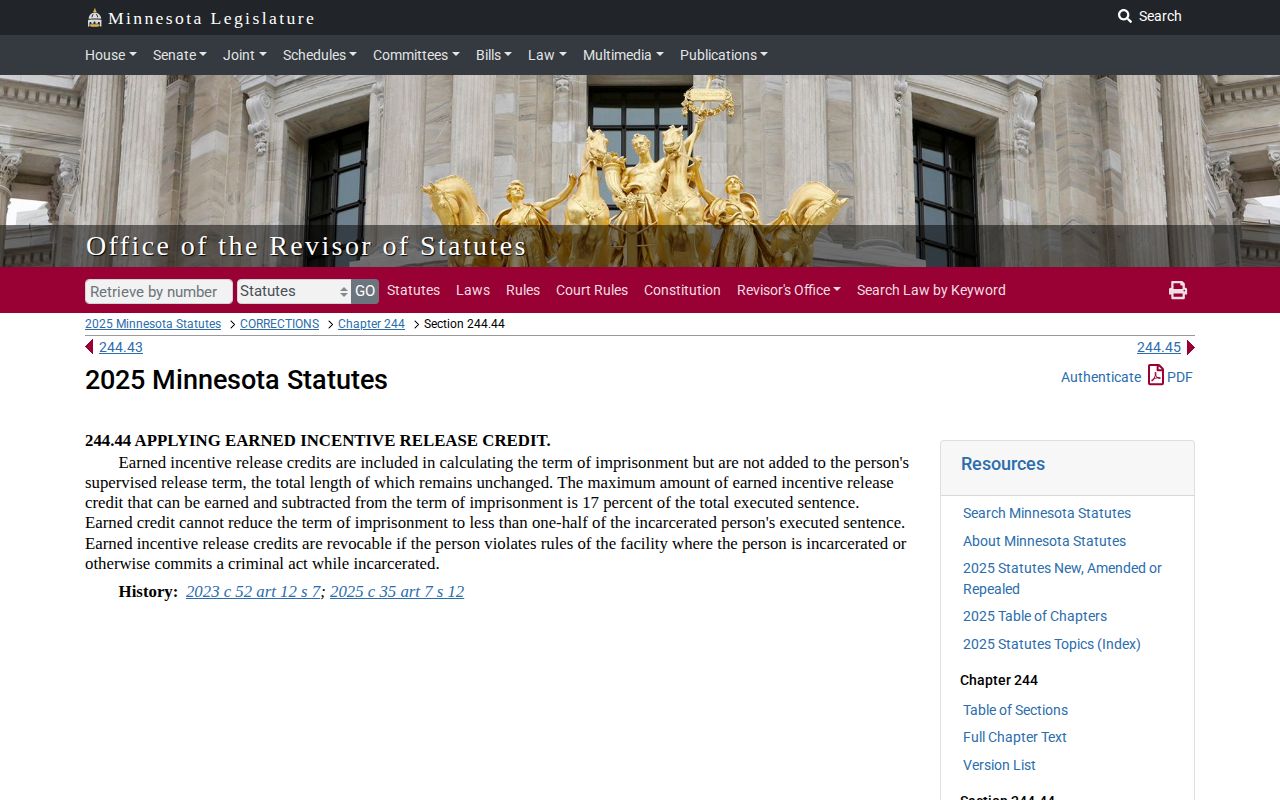
That statutory limit is only one part of the calculation. Jail credit, discipline, consecutive terms, conditional-release periods, and later court action can still affect the date shown on a live DOC record.
Why Mower Release Dates Change
A projected date rests on the record available when the agency calculates it. Changes can occur before the day arrives. The effect also depends on whether the person is in the county jail or state prison. Never apply a state-prison credit formula to a local Mower County jail sentence.
| Factor | Possible effect | Where to verify |
|---|---|---|
| Disciplinary confinement | May delay the prison-to-supervision transition | MN DOC status or offender record |
| Earned credit | May change the prison and supervision allocation within the same total term | DOC calculation and section 244.44 |
| Jail credit | Changes credited custody time in the sentence | Sentencing order and calculation |
| Detainer or hold | May lead to transfer or continued custody elsewhere | Jail or DOC record and receiving agency |
| Court amendment | Can alter the controlling sentence or release order | MCRO and filed order |
| Board action | Can grant, deny, defer, or rescind release in covered cases | Supervised Release Board and DOC |
A transfer is especially easy to misread. Mower County may record the end of its booking even as another authority takes custody. Ask for the transfer recipient under Minnesota's public arrest-data law before describing that event as a return to the community.
Multiple sentences add another layer. Concurrent terms run at the same time, while consecutive terms run one after another. Conditional-release periods for some offenses can extend control beyond the ordinary split. The court judgment identifies the imposed terms, but the corrections calculation applies jail credit, discipline, earned credit, and the governing release statutes. A single date copied without its label and sentence context can therefore misstate the event.
Weekend Mower Release-Date Rule
Minnesota has a distinct calendar rule in section 244.05, subdivision 1a. For crimes before August 1, 1992, a scheduled Friday, weekend, or holiday date moves to a preceding qualifying day. For crimes on or after that date, it moves to the first later day that is not Friday, Saturday, Sunday, or a holiday. The direction therefore depends on the offense date.
This rule can explain why an actual supervised-release start differs from simple arithmetic. It should not be used alone to calculate a date. Offense date, sentence type, discipline, earned credit, special terms, and agency processing must all be correct. County-jail releases do not use the prison Public Viewer projection in the same way.
Mower Jail Release-Date Requests
For a Mower County sentence, use the commitment, jail credit, court orders, holds, and local sentence administration. Call the jail at 507-437-9562 when timing must be checked. If the event has passed, request the existing booking and release record through the Mower County data-request portal. Ask for the booking number, booking time, release date and time, custody status, legal basis, and transfer recipient if one exists.
Minnesota Statutes section 13.82, subdivision 6, treats the date, time, and legal basis for release as public arrest data. It separately covers transfer time, basis, and recipient agency. That distinction can resolve whether the local booking ended in community release or movement to another custodian. The county promises a response as soon as reasonably possible, not a fixed number of days.
Note: A pretrial detainee has no reliable fixed date until the court, bond, jail processing, and all holds allow release.
Confirm a Mower Release Date
Recheck the custodian when the projected day arrives. For county custody, look for a populated release time and `RELEASED` on the current roster or obtain the older record. For state custody, read the Public Viewer status and exact date labels. A projected date alone does not prove that a departure occurred.
VINELink can provide a custody-change notice for a specific person, but it is not the final historical record. The Mower County VINELink release check explains how alerts fit with jail and DOC verification. Compare the alert with the agency record, especially when transfer or another hold is possible. When sources conflict, compare timestamps and identifiers, then request the official record from the custodian that controls the event.
A court order, jail timestamp, DOC date, and VINE alert can all be accurate while describing different steps. Rank them by the question being asked. Use the court for legal authority, the jail for the end of a county booking, DOC for the prison-to-supervision transition, and VINE as a notice that needs confirmation.
Note: Release-date sources were last checked July 24, 2026; statutes, calculations, fields, and individual status can change.